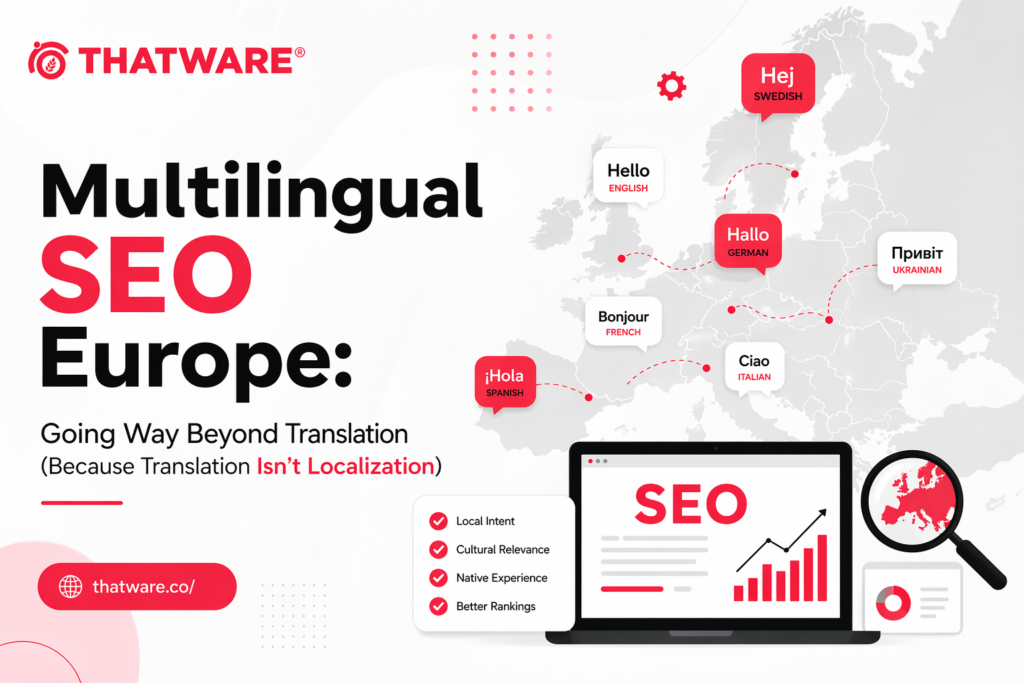
Let’s get something out of the way early: if your European multilingual SEO strategy is “translate our English content into German, French, and Spanish and then optimize the translations,” you’re probably ranking for what people in Berlin, Paris, and Madrid are actually searching for approximately as well as you’d perform in a business meeting where you’d run your opening remarks through Google Translate.
It might technically be in the right language. It does not mean what you think it means. And search engines – and the actual humans using them – can tell.
Multilingual SEO in Europe is genuinely complex work, not because the technical implementation is that exotic, but because doing it correctly requires actually understanding multiple markets rather than just rendering your existing content in multiple languages. The brands getting it right treat each European market as a distinct strategic territory. The ones getting it wrong treat it as a content translation project with some hreflang tags added.
Why Translation Fails as an SEO Strategy
Here’s a concrete example of how translation-only strategies break down. A UK brand selling software tools for small businesses might rank well for “project management software for small teams” in English. They translate that page into German and target “Projektmanagementsoftware für kleine Teams” – a reasonable literal translation.
What they’ve missed: German small business owners searching for this category might be much more likely to search for terms that reflect the German preference for more specific, compound-word queries. The intent signals are similar but the actual search behavior is different. The competitive landscape in German search is different – different incumbents, different trusted brands, different content norms. The features most valued by German business customers may differ from UK customers in ways that should affect how the product is positioned. And the trust signals that convert German prospects are often different from what converts UK ones.
None of that is captured by translation. All of it matters for performance.
The Keyword Research Has to Be Done Natively
This sounds obvious but gets skipped more often than it should: keyword research for each European language market needs to be done in that language, from that country’s search context, ideally with input from someone who actually uses that language as a native or near-native speaker.
Running English keyword research and translating the results is not keyword research in French. French search behavior has its own patterns, volume distributions, and competitive dynamics. What gets searched frequently in France isn’t just the French translation of what gets searched frequently in the UK. Consumer vocabulary varies, regional usage differs, and the intent behind superficially similar queries can diverge in ways that matter for content strategy.
This is one of the clearest dividing lines between multilingual seo services europe that actually work and ones that produce technically compliant but underperforming sites. Native-language keyword research is a prerequisite, not a nice-to-have.
Technical Implementation: Hreflang Done Correctly
Hreflang is the technical mechanism that tells search engines which version of your content is intended for which language and regional audience. Done correctly, it ensures that a French user searching in France sees your French content, not your English content or your Belgian French content. Done incorrectly – and there are many ways to do it incorrectly – it creates a confusing tangle that search engines may partially or fully ignore.
The most common implementation errors worth knowing about: hreflang tags that don’t have corresponding reciprocal tags on the pages they reference (they must be bidirectional), language codes that don’t match the actual language of the content, regional variants (like fr-FR versus fr-BE) that aren’t mapped correctly, and pages included in hreflang that return errors or redirects rather than the correct content.
URL structure decisions also matter more in multilingual contexts than most brands realize. Subdirectories (domain.com/fr/), subdomains (fr.domain.com), and country-code top-level domains (domain.fr) all have different SEO implications, different strengths in establishing local relevance, and different technical overhead to maintain. There isn’t one universally correct answer – but there are answers that are wrong for specific situations, and switching structure later is expensive.
Content Localization Beyond Words
The content differences that matter in European multilingual SEO go beyond vocabulary and grammar. They include format preferences, persuasion patterns, and cultural context.
German content tends to work best when it’s detailed, precise, and demonstrates thorough expertise – readers often expect more depth and specificity than the same content in English would provide. French business content typically benefits from a more structured, logical argument structure with clear progression. Spanish content for Spain versus Latin American Spanish markets differs not just linguistically but in terms of product references, pricing context, regulatory environment, and cultural touchstones.
Visual content has localization considerations too. Imagery, case studies, social proof signals – what resonates with audiences differs across European markets in ways that affect both time-on-page and conversion rates.
Seo agency europe options doing this properly have native-language specialists for each target market, not just translation vendors. The distinction is significant.
Local Link Building Across European Markets
Building local authority in European markets requires local links – and that means building relationships and creating content that earns attention in each specific market, not just translating your English link-building outreach into multiple languages.
Local authority in Germany means being referenced by German-language publications, directories, and industry sites that German users trust. That’s a different set of targets than the French-language sources that matter for French search authority. A multilingual link building program that runs the same outreach templates in five languages is running five relatively ineffective campaigns rather than one effective one per market.
The most effective approach typically involves in-market partners or specialists for each priority European market – people with existing relationships, market knowledge, and the cultural fluency to pitch and place content in ways that work for each specific audience. It’s slower and more expensive than centralized outreach. It also actually works.
Prioritizing European Markets
Most brands can’t invest fully in six or eight European markets simultaneously. Prioritizing wisely – choosing where to invest first based on market opportunity, competitive landscape, and strategic fit – is essential.
The factors worth analyzing: search volume for your category in each market, competitive density (how hard is it to rank in that market?), conversion potential (does the market have commercial characteristics that match your offering?), and execution feasibility (do you have the language and market expertise to do it properly?). A market with high search volume but fierce competition and limited local expertise available may rank lower than a smaller market where you can execute well and where competition is weaker.
European multilingual SEO rewards patient, methodical market-by-market investment more than it rewards spreading resources thin across as many languages as possible. The brands that win long-term in European search typically started by doing one or two markets extremely well before expanding their footprint.